|
|
Gary Novak
Background
|
Second Proof Power gets Absurd at the High Velocity of a Rocket
Power of rocket payload as rate of change in ½mv²
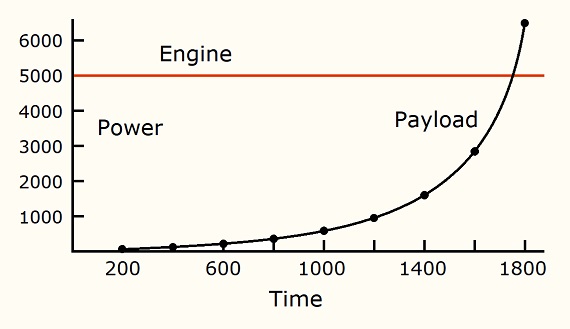
The horizontal line is the power of the rocket engine. The graph and numbers show that the payload can acquire more power (rate of energy addition) than the rocket engine. Where does the payload get that energy? It's supposed to originate with the rocket engine. Acquiring energy at a higher rate than the rocket engine produces shows the contradiction and falseness of the definition of energy that physicists use. Rockets are usually constant powered, meaning they use fuel at a constant rate. Power is rate of energy addition. The power of the rocket with the erroneous definition of energy is 5,000 as shown on the rocket page, which uses the formula provided by The Jet Propulsion laboratory. Mathematically, the power of the rocket mass and exhaust mass are added to create the constant power. But there is a problem with that analysis. As velocity increases, it reaches a point where the power added to the payload is greater power than the engine produces. When the definition of energy is corrected, power is proportional to force only, which is constant, as fuel use is constant. Calculations mo = mass of rocket at start = 21kg m' = rate of mass loss = -0.01kg/s mt = mass of rocket at time T = mo + m't ve = separation velocity of exhaust = 103m/s (pos) F = force = -m've = -(-0.01)(103) = 10 newtons v't = acceleration at time T = F/mt v = velocity = ∫ v'dt = ∫ 10/(mo - 0.01t)dt = ∫ 103/(100mo - t)dt = -103ln(100mo - t) + c(-c is quantity at T = 0) c = 103ln(100m0) = 7650 Shortcut Formula for Velocity: Δ v = veln(m0/mt) With the existing (erroneous) definition of energy, power as rate of energy addition reduces to force times velocity. With simple math, the logic is this: ½mv²/t = ½m·v/t·v = ½mav = ½Fv. The one half is dropped in the simple math procedure, because it was for averaging. More precisely: the derivative of ½mv² with respect to But when evaluating the payload only, there is no change in mass. So the power is force times velocity: KE'p = ½m(2vv') + 0(½v²) = mv'v = mav = Fv (ma equals mass times acceleration, which equals force.) The force acting upon the payload (Fp) is the force of the engine (10 newtons) times the mass ratio (mp/mt). m = 21kg total, payload = 1kg
The Logic Problem The reason why the rocket payload acquires energy as power at a higher rate than the power of the rocket engine is because velocity is an element of power, when energy is defined as ½mv². This means that the rocket engine creates velocity, and then velocity becomes a source of power. |
 |