|
 |
If interferometry existed it would be independent of how far the waves travel; so a mile long tunnel was constructed to make the project too expensive for anyone else to reproduce. Attempting to rationalize the distance shows how obtuse physicists are regardless of whether it is due to known corruption or ignorance.
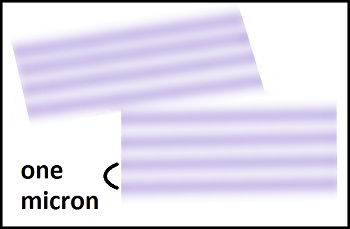
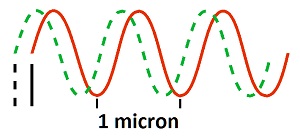
The measurement is in the misalignment of two waves. A variation of 0.1 attometer is said to be detected. The actual distance that the waves travel is of no relevance. It is not measured or analyzed. Only the offset of waves is detected. Yet a path length of four kilometers was used to supposedly improve precision. The light wave is produced by a laser beam which has a wavelength of approximately one micron (one micro meter). The change in distance said to be detected is 0.1 attometer. That's 10 trillion times as much distance in one wavelength as the detected distance change. The laser beam is reflected 280 times, which increases the detection distance change to 28 attometers. That's still 36 billion times less detection distance than the size of one wave of the laser beam. Such a miniscule influence over the laser beam would not really be detectable.
One problem is diffusion of light. Light cannot be created perfect or made perfect after it is created. The imperfections create diffusion. Then the reflection off imperfect mirrors 280 times adds more diffusion. Beam splitters would require heterogeneity of matter and light to split a light wave. The laser light wave was said to be purified by passing it through carbon. That explanation appears to be a mocking reflection upon purification of water by using activated charcoal. No one can say what esoteric schemes physicists might use, but purifying light with carbon is beyond any imaginable process in normal physics. The general rule of light is that anything done to it after it is synthesized makes it less pure (more diffuse). The light detector is said to be a photo diode. I have used silicone based photo diodes, and they are very noisy and low in sensitivity. Cadmium sulfide detectors from the nineteenth century work better, but they wouldn't be controllable enough. The problem with silicone based devices is that they produce a lot of current noise, thermal noise, popcorn noise and drift. The silicone has to be spiked with dopants to create a diode, which creates a lot of variations. Since obfuscation is the standard, a vacuum tube detector, called a photomultiplier, might be used. These puppies create super amplification, which should be good for a lot of contrived magic, except that the more the amplification, the less the resolution, while the degree of resolution is the problem in picking the signal out of 10 trillion times as much background light. Commercial grade silicone produces about one part per thousand noise (not countering other sources of noise that can be designed in). Industrial and military grade silicone reduces noise by a factor of 2-10 less than commercial grade. Vacuum tubes produce noise at about one part per million. There is no technology that can reduce the noise level suitably for the claims being made for gravity wave measurements. Interferometry, if it existed, would not be a realistic procedure for highly demanding measurements due to the crudeness of light waves. At the macro scale, telescopes gathering light create the impression of high precision, but this is due to the accumulation of a large number of waves. At the micro scale, individual waves are used, and they are too diffuse and imperfect for high precision. But physicists exploit the vagaries to create the desired obfuscation and ability to contrive without accountability. Physicists do not normally account for all of the factors which influence their results. In fact, they reduce their calculations to one factor, in part because math cannot handling the increased complexity of interacting factors, and in part because physicists cannot relate one reality to another well enough to understand the complexities. Examples of this are in every element of global warming science. In calculating temperature change in the oceans, climatologists didn't notice that air does not have enough heat capacity to influence ocean temperatures.
|
 | ||||||||||||||