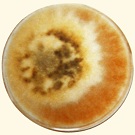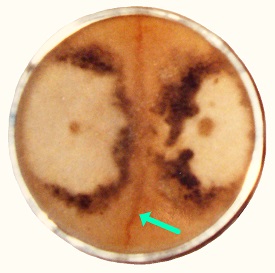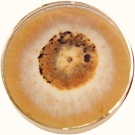
This means the morel was growing on a flat surface so recently that it still carries the pattern for flat surface growth in its DNA; and the DNA transcription can revert to that pattern. It is surprising that DNA can carry a pattern which can no longer be used. The flat-growth-pattern is in fact integrated into the normal pattern, which scrambles the characteristics of the anomaly. The pigments in the anomaly are characteristic of the normal morel strain. In other words, if the strain has a red pigment, it shows up in the anomaly, and if it has a black pigment, it shows up in the anomaly.
Other evidence shows that the morel evolved from a yeast. This includes the physiological production of acid from sugars, which would be very detrimental to normal mycelium. And it includes the use of ascospores, which is very detrimental to any mushroom and points to yeast origins for most ascosporogenous, higher fungi.
When adding this evidence up, it means the morel evolved from a yeast so recently that it can revert back to a yeast-like growth, where there is no macromorphology when growing on a surface.
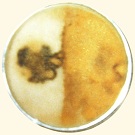
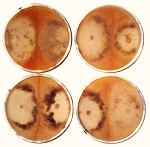 When two spores, even from the same mushroom, are placed on the same plate, they show different phenotypes in the anomaly. There is a zone between the two types of mycelium to prevent the genes from mixing and destroying the phenotypic difference. But Tom Volk showed that about 2% of the time, the zone does not appear, which indicates that some gene exchange is allowed. (See Phenotype Page)